
 Proprietorship Registration
How to Apply for a PSARA License: Complete Registration Process (Online & Offline)

Writen by
Admin

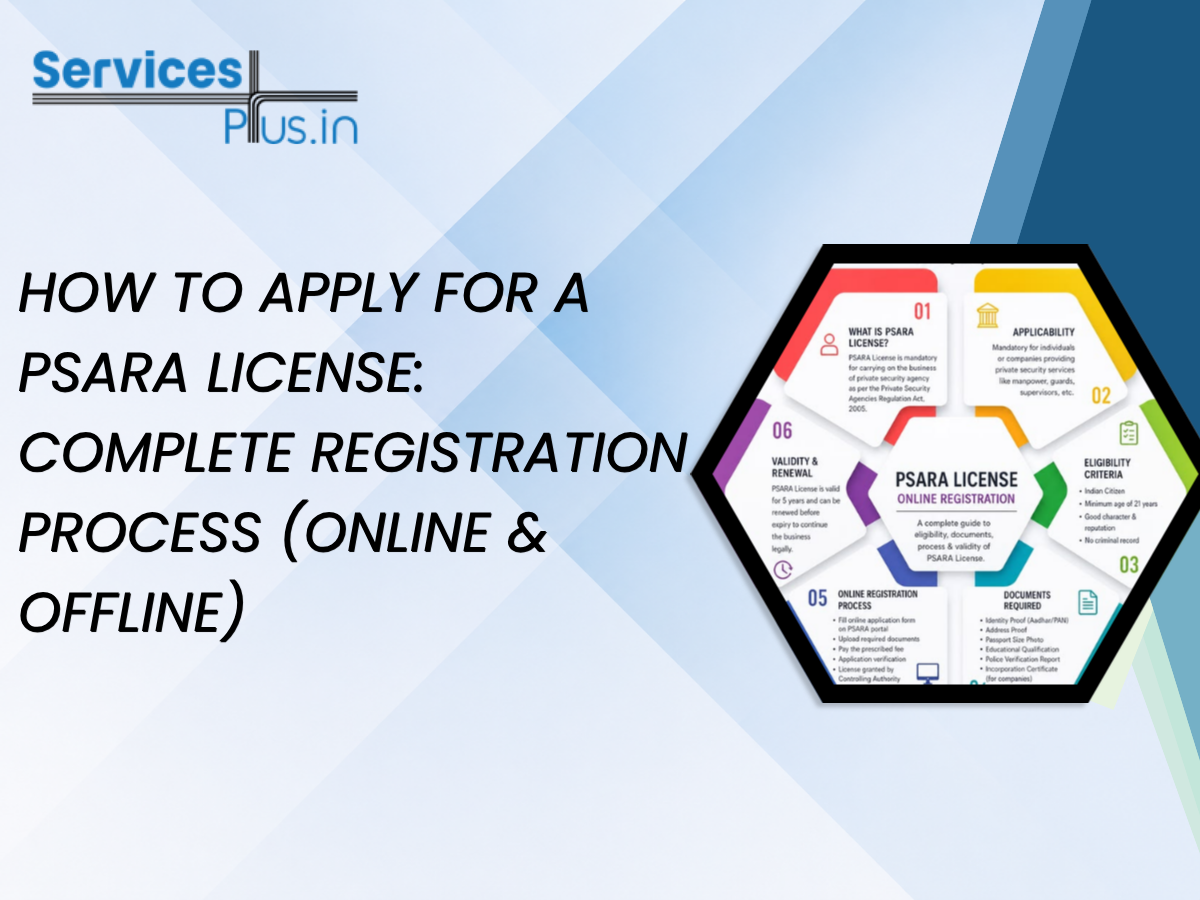
Considering the state of commercial, industrial, and residential expansion and complexity in India (especially in the tier-1 and tier-2 cities), the scope for a private security agency is high at present. But before you start serving clients and posting your security guards there, there is one legal requirement you have to fulfil – apply for and get a PSARA license.
A lot of people put off applying or wait till the last moment because they usually find the process a bit confusing. Which form do you fill? Is it online or offline? What if you miss a document? Here's the truth — the PSARA license registration process is actually pretty straightforward once you know the sequence. This guide walks you through it, step-by-step, so you can apply with confidence instead of indulging in guesswork.
For a full breakdown of eligibility, license types, and state-wise rules, check our PSARA License guide first. This blog details the actual "how do I file for PSARA license" part.
The Ministry of Home Affairs runs a central online portal — psara.gov.in — where most states plug in their application process. It's a genuinely useful starting point, since it also carries state and district-wise licensing information in one place.
But here's the catch worth remembering: your license doesn't come from a central body. It comes from your state's or Union Territory's Controlling Authority, because PSARA licenses are issued for specific districts or states, never for the whole country in one go. Each state can also have its own forms and checklist layered on top of the central process. So don't assume West Bengal's requirements match Karnataka's or that a document list from one state's site will work everywhere.
You can't apply for a PSARA license as an individual working alone. You need a proper business entity first. This can be:
Whoever runs the show — the proprietor, partners, or directors; they must be Indian citizens, at least 18 years old, and free of any criminal record. This eligibility condition traces back to Section 6 of the PSARA Act, and it's checked, not just assumed. If your business documents don't clearly mention "security services" as an activity, expect a query from the authority before your application even moves forward.
Two other structures are technically eligible too, though you won't see them often in this industry:
Bottom line: while the rules don't shut the door on these two, almost every agency you'll come across is a proprietorship, partnership, LLP, or private limited company, because that's what actually fits how a security business operates day-to-day.
Want the full list of disqualifying conditions and citizenship rules? Check our PSARA license registration in India guide; it is worth a read if you're unsure whether you qualify.
Don't start the application halfway through gathering paperwork. Get everything ready first. Here's what you'll typically need:
Missing even one of these can stall your file for weeks. Keep scanned copies ready before you touch the online form — it saves you from restarting halfway through.
Here's the actual sequence, laid out plainly.
Your agency has to be a legally registered business before you even think about PSARA. No unregistered outfit can apply. Most agencies go with an LLP or a private limited company, mainly because it builds more trust with corporate clients later.
This one catches people off guard. Under Section 9 of the Act, agencies are required to train their guards and supervisors through a proper process, not just any training center. Each state publishes its own list of approved institutes, processes,central portal even has a "Know Your Training Institutes" section where you can verify one before signing anything. You need this MOU signed before filing, not after.
Pull together everything from the checklist above. Double-check spellings, addresses, and dates across all documents. Here's a real pattern worth knowing: a name spelled slightly differently on the Aadhaar card versus the incorporation certificate is one of the most common, avoidable reasons applications get delayed.
This part genuinely varies. Some states run a fully online system through their home department or police portal, feeding into the central psara.gov.in framework. Others expect you to complete an online form and then walk in with physical documents for verification. A handful of states still process everything offline through the Controlling Authority's office.
Don't assume: check your specific state's portal before you start to know which states support what, along with local fee differences.
This is the actual application form — officially called Form I. If your state has an online portal, you'll create an account, enter your business and director details, upload the documents, and pay the application fee. If it's offline, you'll submit the physical form to the Controlling Authority along with your documents.
Take your time here. A rushed submission with mismatched details is exactly how applications end up sitting in limbo for months.
The government fee is set under Section 7(3) of the Act and depends on how wide your area of operation is:
|
Area of Operation |
Government Fee |
|
One district |
₹5,000 |
|
Up to five districts |
₹10,000 |
|
Entire state |
₹25,000 |
Keep in mind, this is just the statutory application fee. Your real budget should also account for documentation costs, training arrangement expenses, and professional assistance if you choose to use it. Some states also charge above this central slab, so it's worth checking your state's exact numbers before you plan your costs.
Once submitted, the police department runs a background check on the applicant, directors, or partners. Verification today runs through systems like CCTNS and ICJS, which link police records digitally and speed up the process compared to the old manual method. Even so, this step usually takes the longest, and it's largely out of your hands once it starts. Incorrect names or address mismatches at this stage can create real delays, so accuracy earlier in the process really does pay off here.
Keep your application number, payment receipt, and portal login safe. Many state systems let you check your application status online, so you'll know if something's pending or if the authority needs more information from you. If you do get a query, respond with exactly what's asked — don't flood them with extra documents hoping something sticks.
Once everything checks out, the Controlling Authority issues your PSARA license, which is usually done within 60 days of a complete application, as laid out under Section 7. If something's incomplete or doesn't meet the requirements, the authority can refuse the license, but you're entitled to know the reason behind that refusal. A license, once granted, is valid for five years.
A few small errors cause most of the delays applicants run into:
Avoid these, and your application has a genuinely smooth path forward.
The PSARA license registration process isn't complicated once you break it into steps. Register your business, tie up with a training institute, gather your documents, file Form I through the right channel for your state, pay the fee, and let verification run its course. That's really it — and once you have the license, remember it's not a one-time formality. Compliance obligations continue for as long as you hold it.
If you'd rather not navigate the paperwork and portal quirks yourself, services plus handle PSARA license applications end-to-end — from documentation to filing to follow-up. If you want, you can head back to our PSARA License page to get detailed info on each aspect, alongside how to apply online.
Most states allow full online filing through their home department portal or the central psara.gov.in framework, though some still require offline document submission alongside it.
Form I is the official application form used to apply for a PSARA license, covering your business and director details for verification.
Yes. Signing an MOU with a state-approved training institute is mandatory before you submit your application.
Section 7 of the Act allows up to 60 days for a complete application, but the real timeline depends on how quickly police verification and inspection go, and how clean your paperwork is.
No. Licenses are state-specific, so you need to apply separately in every state where you plan to operate.
You'll need identity and address proof, incorporation documents, a police clearance certificate, an affidavit, and your training institute MOU.
Yes. Every director, partner, or proprietor involved goes through police verification, run through systems like CCTNS and ICJS.
It's valid for five years, and you'll need to file for renewal well before it expires — most states require this at least 45 days ahead — to avoid a gap in your operations.




with free consultation